

Posted on

The Benefits of Using Matter in a Smart Home

Matter smart home
Matter logo representing the universal smart home connectivity standard

Smart homes have come a long way from simple remote controlled lights and thermostats. Today, the focus is on seamless integration, reliability, and user friendly experiences. One of the most exciting developments driving this evolution is Matter, a new universal standard designed to unify smart home devices across brands and platforms.

But what exactly makes it so valuable, and why should homeowners care?

1. True Interoperability Across Devices

One of the biggest frustrations in building a smart home has always been compatibility. Different brands often require their own apps, hubs, or ecosystems, making it difficult to connect everything smoothly. Matter solves this problem by creating a shared standard that allows devices from different manufacturers to communicate effortlessly.

This means you can buy a smart bulb from one brand, a thermostat from another, and a smart lock from a third, all confident they’ll work together without complicated setup processes or workarounds.

2. Simpler Setup and User Experience

Matter is designed with simplicity in mind. Devices that support this standard can typically be set up quickly using a single app or even by scanning a QR code. There’s no need to juggle multiple apps or follow lengthy installation steps.

For homeowners, this means less time troubleshooting and more time enjoying the convenience of a connected home.

3. Improved Reliability

Unlike some older smart home systems that rely heavily on cloud connections, Matter emphasises local communication. Devices can talk to each other directly within your home network, which leads to faster response times and fewer disruptions when internet connectivity is unstable.

For example, your lights will still turn on instantly when you press a switch, even if your internet is down.

4. Enhanced Security and Privacy

Security is a major concern in any connected environment. Strong encryption and standardised security protocols are included to help protect your data and devices.

Because many interactions happen locally rather than through the cloud, there’s also less exposure to external servers. This adds an extra layer of privacy and control for users.

5. Future Proofing Your Smart Home

Technology evolves quickly, and no one wants to invest in devices that become obsolete within a few years. Matter is backed by a wide range of major tech companies and is designed to be forward compatible.

6. Greater Flexibility and Freedom of Choice

You are no longer locked into a single ecosystem. You can choose devices based on features, price, or design rather than compatibility concerns.

This freedom encourages competition among manufacturers, which can lead to better products and more affordable options for consumers.

7. Streamlined Smart Home Control

Matter allows multiple platforms to control the same devices. Whether you prefer voice assistants, mobile apps, or automated routines, you can manage your smart home in a way that suits your lifestyle.

This flexibility creates a more personalized and intuitive experience.

Conclusion

This represents a major step forward in smart home technology. By prioritising interoperability, simplicity, security, and reliability, it removes many of the traditional barriers that have held smart homes back. Instead of dealing with fragmented ecosystems and compatibility issues, users can now enjoy a more cohesive and dependable connected environment.

As adoption continues to grow, it is likely to become the standard foundation for smart homes worldwide. This means that investing in Matter enabled devices today is not just a short term convenience, but a long term strategy for building a smarter, more adaptable home. Whether you’re just getting started or upgrading an existing setup, it offers a level of flexibility and confidence that was previously hard to achieve.

Ultimately, this brings the smart home closer to what it was always meant to be: simple, secure, and truly interconnected, making everyday living more efficient, comfortable, and future-ready.

Click here to read more about Matter and here go back to our blog.
Posted on

Understanding Zigbee: A Versatile, Wireless Solution for Smart Homes

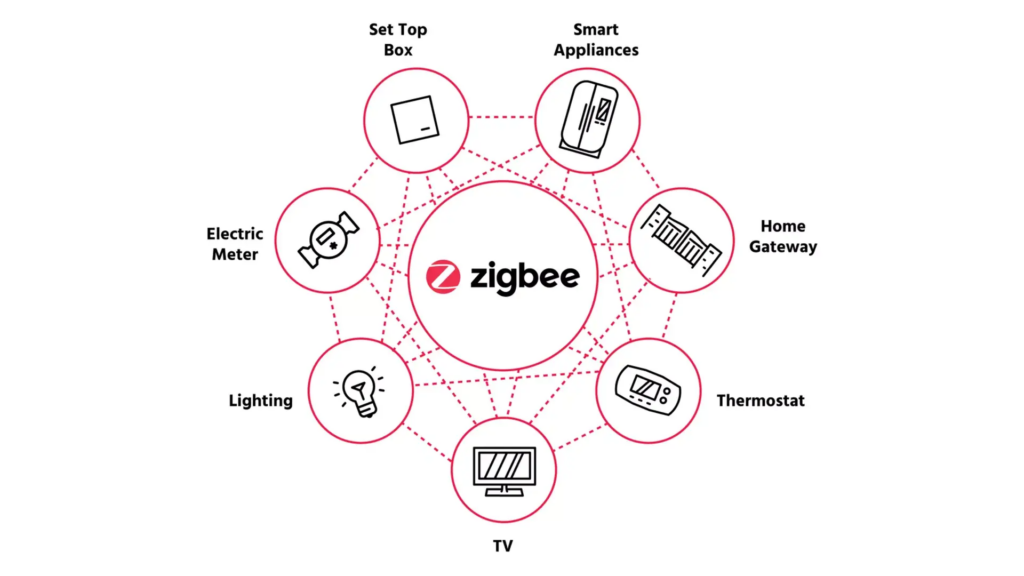
Zigbee has emerged as a popular choice for those looking to create a seamless and efficient network of connected devices.
Zigbee creating a seamless and efficient network of connected devices.

In today’s connected world, smart home technologies are becoming more accessible, and Zigbee is one of the key wireless protocols driving this revolution. If you’re exploring smart home solutions or have heard about devices like light bulbs, or security sensors that can “talk” to each other, then Zigbee is something you should know about. This blog will break down what it is, how it functions, and why it’s a flexible and efficient solution for building out your smart home, whether you use a vendor hub or choose platforms like OpenHAB or Home Assistant

What is Zigbee? 

It is a wireless communication protocol designed for low power, low data rate applications, such as home automation, lighting, and security systems. It’s particularly popular for creating wireless networks that can link a variety of devices, ranging from lights to sensors to locks, and is known for its mesh networking capabilities. 

The primary goal of is to enable smart devices to communicate with each other efficiently, requiring very little power. This makes it ideal for battery powered gadgets that don’t need constant high speed internet connectivity. 

How Does Zigbee Work? 

It operates on the IEEE 802.15.4 standard, using the 2.4 GHz frequency band, the same as Wi-Fi, but with a much simpler and lighter communication protocol. Here’s a breakdown of some of its key characteristics: 

  1. Low Power Consumption: Devices that communicate using it are incredibly energy efficient. Many devices can run for years on a single battery, making them ideal for sensors or remote control applications. 
  1. Short Range (But with a Twist): While a single device might only communicate over a short range (up to 100 meters in ideal conditions), its true strength lies in mesh networking (explained below). 
  1. Mesh Networking: Devices don’t need to communicate directly with a central hub. Instead, they can form a mesh network where each device acts as a relay, passing messages along to other devices. This increases range and ensures that communication is reliable, even if one device is out of direct range from the hub. For example, if a sensor is too far from the central hub, it can communicate with a nearby light bulb, which then relays the signal to the hub. 
  1. Low Data Transfer Rates: Zigbee is not designed for high bandwidth applications like streaming video. It is most effective for sending small packets of data, such as temperature readings or on/off commands for lights. 

The Flexibility of Zigbee: Vendor Hubs or Independent Platforms 

One of the most attractive features is its flexibility. Depending on your preference, you can use it with a vendor’s hub or set up a hub free system on platforms like OpenHAB or Home Assistant

Using Zigbee with a Vendor Hub 

Many popular smart home hubs, such as Tuya, Smart Life, Philips Hue, Amazon Echo Plus, and Samsung SmartThings, use Zigbee to communicate with their devices. These hubs offer user friendly interfaces, making it easy to control a smart ecosystem through a single app. However, there is one caveat: if you use a vendor’s hub, you may be limited to that brand’s ecosystem or require additional integrations to work with devices from other manufacturers. 

Without a Vendor Hub: Home Assistant or OpenHAB 

For tech savvy users looking for more control and customization, these devices can be integrated into opensource platforms like OpenHAB and Home Assistant. Both platforms allow you to set up a more flexible and independent smart home network, free from vendor lock in. By using a Zigbee USB dongle or coordinator, you can directly connect devices to these platforms and automate them according to your preferences. 

Here’s how this setup differs from using a vendor hub: 

  • Interoperability: You can combine devices from different manufacturers without worrying about whether they’re part of the same “ecosystem.” 
  • Customisation: You have full control over your automations and can tweak the system to suit your needs. 
  • Cost Effectiveness: Open-source platforms like OpenHAB and Home Assistant are free, making them an affordable option for those willing to invest time in setup and configuration. 

Zigbee vs. Other Smart Home Protocols 

You might wonder, how does Zigbee stack up against other popular smart home protocols, like Z-Wave or Wi-Fi? 

  1. Zigbee vs. Z-Wave: Both Zigbee and Z-Wave are mesh networks, but Z-Wave operates at a lower frequency (900 MHz), compared to Zigbee, which uses 2.4 GHz. However, Zigbee can support more devices on a single network and has a higher global adoption rate, meaning more available products. 
  1. Zigbee vs. Wi-Fi: While Wi-Fi is common in homes, it’s not as efficient for low-power devices, like sensors or smart bulbs, because of its high energy consumption and more complex protocol. Zigbee is built for this exact purpose simple, low power communication that doesn’t hog your network bandwidth. 

Conclusion 

Zigbee is a robust, flexible wireless protocol that’s ideal for building a reliable and scalable smart home network. Whether you’re just starting out with a few smart lights or building a complex home automation system with sensors, cameras, and thermostats, it offers both convenience and flexibility. You can either use a vendor’s hub for a plug and play experience or go the opensource route with platforms like OpenHAB and Home Assistant for full control of your smart home. 

By understanding how Zigbee works and its unique mesh networking capabilities, you’ll be well on your way to creating a smart home that fits your needs perfectly.